05.07.2021
Views: 1040
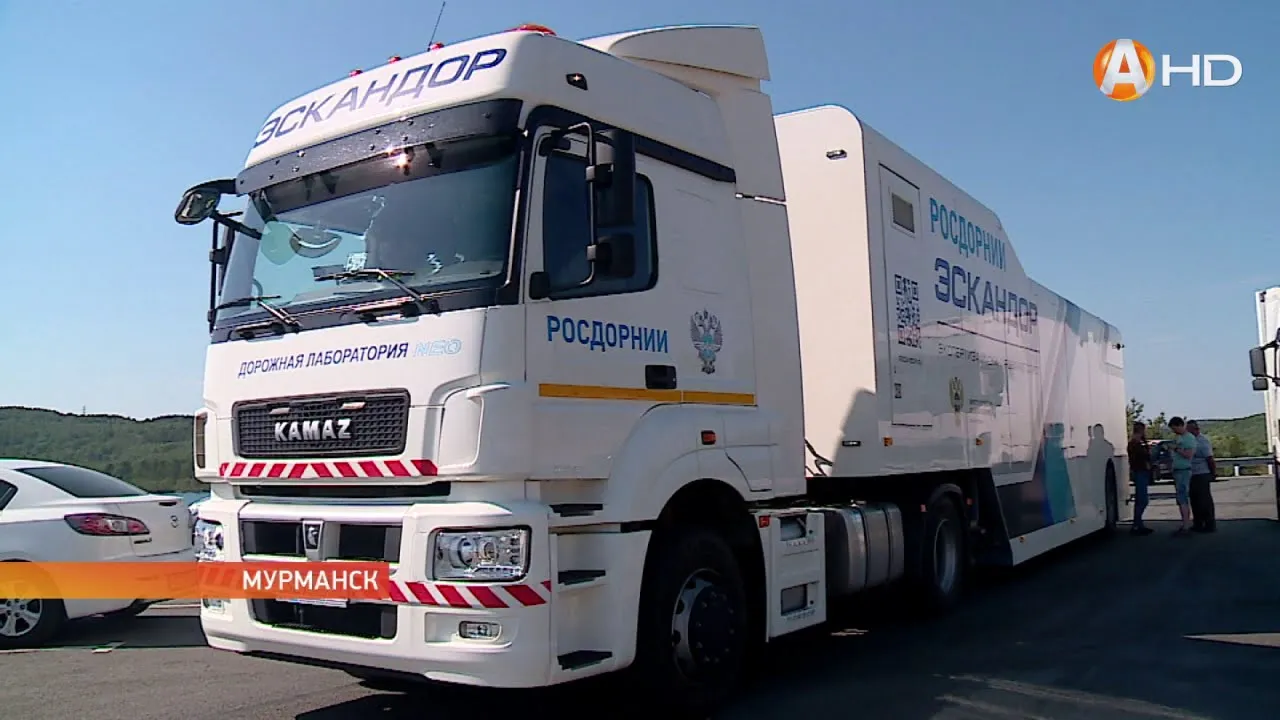
A unique modern mobile laboratory "Eskandor" is starting work in the Murmansk region. It will create a digital twin of the region's roads, based on the data obtained, the most vulnerable sections of the roadway that require repair in the first place will be determined.
New roads – high-tech checks! A special mobile laboratory on wheels has arrived in the polar capital.
The mobile laboratory "Eskandor" arrived in Murmansk. It is made on the basis of the chassis of the KAMAZ truck, the main technical filling is in the trailer of the tractor. The car is equipped with the most modern equipment that scans the roadway in real time. Scanning is carried out using a laser while the car is moving.
Denis Kovalev, head of the department of modeling the interaction of the car with the road of FAO "ROSDORNIA": "The laser sends a signal to the road, then the receiving sensor detects changes from the position of the beam from all kinds of irregularities on the road."
The scanned data is stored on the internal server, where their initial processing begins. During the work of the laboratory, the speed of the car should be in the range from 30 to 70 km/h.
In addition to laser technology, the machine is equipped with many other sensors and even a ground-penetrating radar. Such an impressive "filling" can help create a full-fledged 3D model of a problematic road section.
Sergey Mokrousov, Deputy Head of the Transport Planning Department of FAO "ROSDORNII": "All existing technologies make it possible to identify the surface shortcomings of the highway: this is a track, these are potholes, cracks, some irregularities longitudinal and transverse. Our laboratory allows us to identify and calculate the strength of the pavement on any part of it."
"Eskandor" is a unique system, there are only 20 such machines in the whole world, and our region is the first region in Russia where the auto laboratory will start its work.
Artem Grishin, Minister of Transport and Road Management of the Murmansk region: "Why is the Murmansk region the first? Because the developments that we have made in creating a single platform for the management of the transport system, in creating a data center, allow us to receive data from the "Eskandor", process them, analyze and get an array of data for further work."
First results The Regional Ministry of Transport plans to receive it this fall. The car also interested the heads of MSTU, where in September they will begin teaching students in the specialty: road engineer.
Viktoriya Yatsenko, Vice-Rector for Academic Affairs of MSTU: "I hope that with the support of the Ministry of Transport and Road Construction of the Murmansk Region, our students will be able to get acquainted with the content of this laboratory, with the principles of its work, with digital technologies that are used there."
"Eskandor" will work within the framework of the national project "Safe and high-quality roads". The laboratory will not only diagnose the condition of the asphalt pavement, but will also help to form a digital twin of the region's roads, which will be useful for future work.
New roads – high-tech checks! A special mobile laboratory on wheels has arrived in the polar capital.
The mobile laboratory "Eskandor" arrived in Murmansk. It is made on the basis of the chassis of the KAMAZ truck, the main technical filling is in the trailer of the tractor. The car is equipped with the most modern equipment that scans the roadway in real time. Scanning is carried out using a laser while the car is moving.
Denis Kovalev, head of the department of modeling the interaction of the car with the road of FAO "ROSDORNIA": "The laser sends a signal to the road, then the receiving sensor detects changes from the position of the beam from all kinds of irregularities on the road."
The scanned data is stored on the internal server, where their initial processing begins. During the work of the laboratory, the speed of the car should be in the range from 30 to 70 km/h.
In addition to laser technology, the machine is equipped with many other sensors and even a ground-penetrating radar. Such an impressive "filling" can help create a full-fledged 3D model of a problematic road section.
Sergey Mokrousov, Deputy Head of the Transport Planning Department of FAO "ROSDORNII": "All existing technologies make it possible to identify the surface shortcomings of the highway: this is a track, these are potholes, cracks, some irregularities longitudinal and transverse. Our laboratory allows us to identify and calculate the strength of the pavement on any part of it."
"Eskandor" is a unique system, there are only 20 such machines in the whole world, and our region is the first region in Russia where the auto laboratory will start its work.
Artem Grishin, Minister of Transport and Road Management of the Murmansk region: "Why is the Murmansk region the first? Because the developments that we have made in creating a single platform for the management of the transport system, in creating a data center, allow us to receive data from the "Eskandor", process them, analyze and get an array of data for further work."
First results The Regional Ministry of Transport plans to receive it this fall. The car also interested the heads of MSTU, where in September they will begin teaching students in the specialty: road engineer.
Viktoriya Yatsenko, Vice-Rector for Academic Affairs of MSTU: "I hope that with the support of the Ministry of Transport and Road Construction of the Murmansk Region, our students will be able to get acquainted with the content of this laboratory, with the principles of its work, with digital technologies that are used there."
"Eskandor" will work within the framework of the national project "Safe and high-quality roads". The laboratory will not only diagnose the condition of the asphalt pavement, but will also help to form a digital twin of the region's roads, which will be useful for future work.
Источник:
Arctic-TV Channel