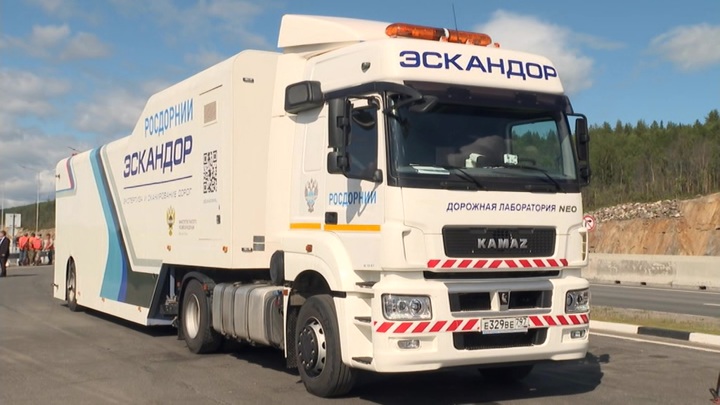
The mobile automotive laboratory of ROSDORNIA "Eskandor" has arrived in the Murmansk region to study the strength of highways. The Kola Polar Region has become the first subject in the country where a system with scanners and radars will perform diagnostics of the road surface under the national project "Safe High-quality Roads". There are only about 20 similar machines in the world, this one is the first in Russia. Here she will completely "digitize" the roadbed for further planning of repairs.
Artem Grishin, Minister of Transport and Road Management of the Murmansk Region: "Why Murmansk region? Because the developments that we have made, namely the creation of a Single platform for managing the transport system, the creation of a data center, allow us to receive data from the "Eskandor", process them, analyze them and, accordingly, already have them in operation."
Deputy Head of the Transport Planning Department of ROSDORNII Sergey Mokrousov: "Existing technologies make it possible to identify the superficial shortcomings of the highway. This is a track, these are potholes, cracks, some irregularities longitudinal and transverse. Our laboratory allows you to identify and calculate the strength of the pavement on any part of it."
The autolab will also evaluate the depth and profile of the track where it is, and coupling properties. All the information received will help to timely plan the replacement of the road surface on those routes that need it in the first place. In addition, Murmansk Technical State University intends to use the data of "Eskandor" to train students.
Vice-Rector for Academic Affairs of Murmansk State Technical University Victoria Yatsenko:"This year our university announces recruitment for full-time education in the profile "Highways", the direction of training "Construction". And I hope that with the support of the Ministry of Transport and Road Management of the Murmansk region, our students will be able to familiarize themselves with the contents of the laboratory and with the principles of its work."
Sergey Shiryaev.
Источник: