In 2020, a large-scale upgrade of equipment is taking place in the stationary laboratories of the FAU "ROSDORNIA" within the framework of the national project "Safe and High-quality Roads". The new equipment will be used in the framework of quality monitoring (audit) for testing road construction materials for compliance with the requirements of existing regulatory and technical documents. We tell you about the installations and devices in detail.
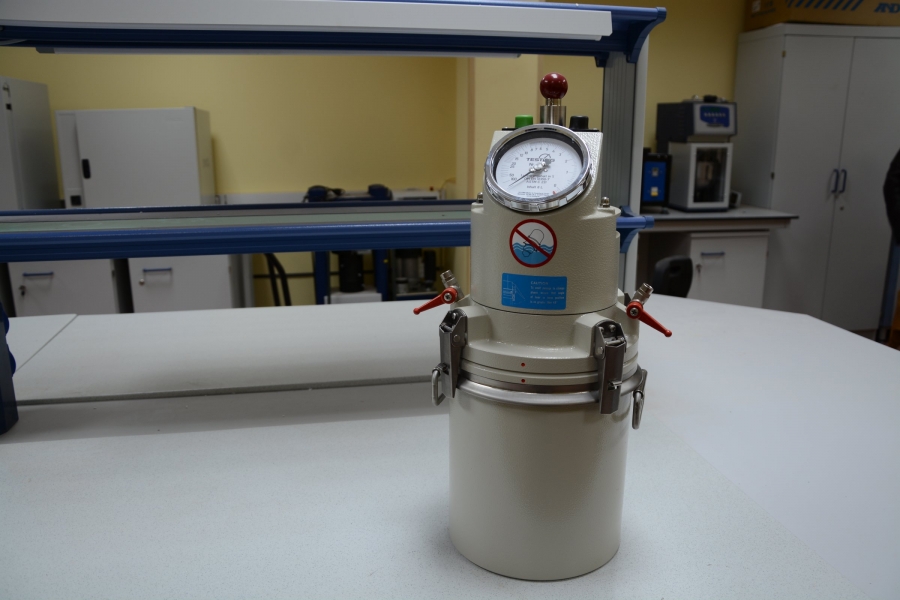
The meter is used to determine the indicator of the entrained air in the concrete mixture. The test is carried out in accordance with GOST 10181-2014 "Concrete mixtures. Test methods". The entrained air content is the most important indicator for a concrete mix when designing concretes with a given frost resistance.
Since this device is mobile, the test can be carried out both on a sample of a freshly prepared mixture at a concrete plant, and directly at the concreting site. The principle of operation of the poromer is to equalize a known volume of air, at a known pressure, in a sealed air chamber with an unknown volume of entrained air in a sample of concrete mixture.
The device has a pressure chamber in which a certain pressure is created with the help of a pump. After opening the connecting valve, the pressure in the pressure chamber and in the vessel with concrete is equalized. The decrease in air pressure in the pressure chamber is a measure of the air content in concrete or mortar.
The device is equipped with an integrated pressure gauge, and also has buttons for quick testing. The pore meter can be used to test the concrete mix of the entire product range, including a mixture with a filler size of over 40 mm.
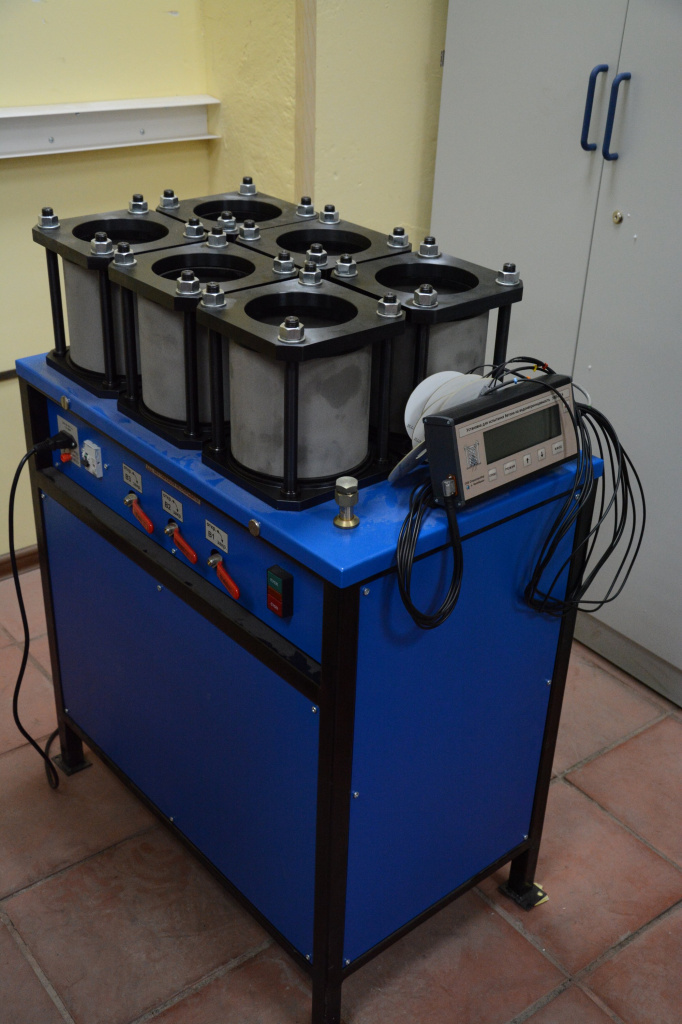
The installation for testing concrete for water resistance is designed to test concrete samples of cylinders for water resistance using the "wet spot" method and filtration coefficient in accordance with GOST 12730.5-2018 "Concrete. Methods for determining water resistance". The method for determining water resistance by "wet spot" is based on measuring the maximum pressure at which no water seeps through the sample. In particular, it can be used to assess the corrosion resistance of structures. The method of determining the water resistance by the filtration coefficient is based on the determination of the filtration coefficient at constant pressure according to the measured amount of filtrate and filtration time.
To test concrete for water resistance on a wet spot, a predetermined water pressure is transmitted to the end surface of a cylindrical sample or a core sample taken from structures using the installation, which is maintained constant for a certain time. The test is considered completed when water appears on the reverse side of the samples, that is, water under pressure penetrates through the entire sample. At this point, the pressure value is fixed and a water resistance indicator is assigned.
To test concrete for water resistance by the filtration coefficient, a predetermined water pressure is transmitted to the end surface of a cylindrical sample or core sample taken from structures using the installation, which increases in steps. Unlike the previous method, where only the water pressure is recorded, in this case, there is also a periodic intake of filtered liquid in the planned period of time. Every 30 minutes, throughout the entire test period, the filtrate is collected and weighed from all samples participating in the study. Then the values of all measurements of the weight of the liquid are determined on each individual sample and based on these indicators, using a special formula, the filtration coefficients are calculated. And then the filtration coefficient for the concrete under study is calculated.
The installation ensures that concrete samples are tested for water resistance in automatic mode. The operation of the installation is controlled by a microcontroller in accordance with the initial data set by the operator, while raising and maintaining water pressure, holding on the stage, fixing the time of the appearance of a "wet spot" on each of the samples and stopping the tests is carried out automatically.