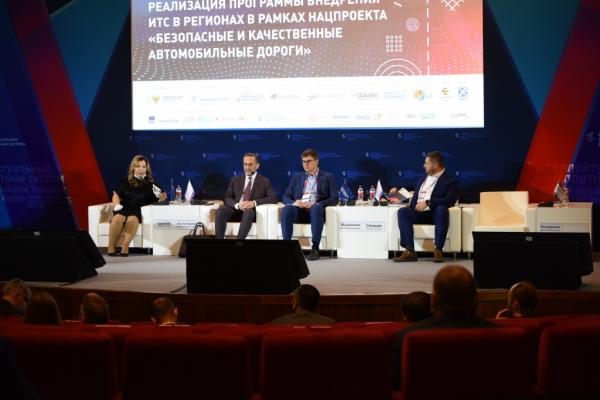
The key theme of the exhibition was identified as follows: "What? Where? When? in the digital transformation of the transport complex". For two days, ITS leading experts discussed the digitalization of the industry in a live discussion format. And there were a lot of reasons for controversy, because 2020 is rich in events in the field of digital technologies in transport: the development and testing of unmanned traffic in Russian cities continues, while the regions are already forming ITS implementation programs. The forum was held with the support of the Ministry of Transport of the Russian Federation, the Federal Road Agency, the Association "Digital Era of Transport" (co-organizer of the forum) and the Association "R.O.S.ASPHALT". The general partner of the event was the FAA "ROSDORNII".
The first day of the forum was opened by a plenary discussion on the topic "Digital transformation of the transport industry". The speaker from the scientific institute wasEkaterina Bryazgina, ITS Development Director FAA "ROSDORNII". In the speech, it was said that this year 22 regions of the Russian Federation have been allocated a total of 3,347.5 million rubles for the project of introducing intelligent transport systems. But this process is not easy, because in the regions we have to deal with insufficient qualifications of personnel and the lack of necessary initial documentation. Experts of the scientific Institute, when communicating with representatives of the subjects of the Russian Federation, also face a misunderstanding of the tasks of the project as a whole:
"Events such as this, our round tables allow us to convey to the regions that the introduction of ITS is not just an opportunity to attract federal funds for cameras and weight and size control points. So far, many participants do not have an understanding of the essence of the project, even in large cities, even in some million-plus cities. We are waiting for the regions to start implementing ITS and will tell themselves about their cases at such events," Ekaterina Bryazgina shared.
The Institute proposed that from 2025 the best experience of intelligent transport systems should be replicated to subjects and agglomerations that are not included in the national the BKAD project.
At the moment, on the basis of the scientific Institute, four draft national standards are being developed on the topic of information security and digital road models.
The participants of the plenary discussion confirmed that the creation of intelligent transport systems is now a very difficult organizational task and proposed to use the chief designer mechanism in the constituent entities of the Russian Federation to solve it, a practice that has proven itself well in creating complex technical and technological tasks.
The next block of the forum was devoted to the topic of connected and highly automated transport, the moderator of the meetingAnton Zhuravlev, President of the Digital Era of Transport Association, presented it as follows:
"Unmanned transport seemed like a fantasy until recently, a kind of "hype" concept, but now it's a reality. The number of drones being tested on Russian roads is growing, and the question of their regulatory regulation arises."
The discussion started with a speechMikhail Belov, Deputy Head of the ITS Department of the FAU "ROSDORNII". He began by saying that ensuring the safe movement of unmanned vehicles is impossible without the use of intelligent road infrastructure.

It is very important, according to the expert, already now, when creating ITS in urban agglomerations, to ensure the use of functionally compatible technical and technological solutions. If you don't think about it, then by 2025 ITS will start functioning, but there will be no consistency and compatibility between regions:
"We want to achieve "seamless", that is, comfortable movement of transport, including between regions. Our task is to provide logistics, and not just to put a super traffic light. Therefore, a National ITS network is so necessary, I will compare it with a children's toy, a pyramid, where the network is a stick on which pancakes of different colors are strung," Mikhail Belov stressed.

It is assumed that the National Network will be to ensure the unity of approaches in the development, and in regulatory regulation, and in the order of accession, and in the use of technologies that have been tested. And if these conditions are met, it will be possible to talk about comfortable and safe movement of connected transport, and in the future, unmanned transport.
Next, it was about the advantages of unmanned transport. The main thing is that its use will reduce the accident rate on Russian roads by up to 70%, there will be predictability of travel time. In addition, such public transport will become more attractive than individual, and a large number of parking lots will no longer be required, and accordingly, additional space for landscaping will appear in cities.
The experience in the field of highly automated transport in Russia is already considerable: everyone is familiar with the Lastochka regular train, Mostransproject, Yandex and StarLine companies are testing their automated passenger cars in major cities of the country, KAMAZ has announced the launch of production of cargo drones in 2025.
The first day of the forum ended with the session "Comfortable urban environment: infrastructure, mobility, public transport". The issues of transport planning and modeling of urban agglomerations, development of the public transport network and automation of passenger transportation were touched upon. The expert from the FAA "ROSDORNIA" wasVladimir Pashchenko, Head of the Transport Planning Department:
"After the discussion about drones, it's sad to talk about it somehow, but you need to be honest with yourself - there can be no question of any development of public transport, while minibuses dominate in Russian cities as a phenomenon, as an economic model. Their income depends only on the number of passengers transported, so they are ready to fight for each of them, avoid taxes by cash settlement, save money by servicing and storing transport outside enterprises. The secret of their success is breaking everything that is possible. The minibus as an economic model should remain in the past," Vladimir Pashchenko outlined the problem.
The way out is to reform the transport system, in which the basis of the economy should be the order of transport work. In this model, the carrier's source of income is it becomes the budget, not the wallet of the passenger who pays for travel not to the carrier, but to the city. Of course, federal support measures for passenger transport should be increased, especially for those cities that are switching to a new management model. At the forum, the expert for the first time published data on how much transport the regions will receive under the preferential leasing program as part of the BCAD national project in 2021. FAA "ROSDORNII" actively participated in the selection of agglomerations that applied for participation in the event. As a result, the expert commission of the Ministry of Transport identified 12 winning cities that will receive 275 buses, 104 trolleybuses and 13 trams.
The event on updating the rolling stock of urban transport in the near future should develop into a comprehensive program of modernization of passenger transport, which is being developed on behalf of the President of the Russian Federation. The Scientific Institute expects that this program will be able to cover not only the renewal of rolling stock, but also the tasks of modernization of passenger transport infrastructure, and will involve qualified transport planning, optimization of route networks in cities taking into account the agglomeration approach, the priority of the regulated tariff, the introduction of digitalization tools.
Answering questions from the audience, the speaker also outlined his position:
"We talk about technologies all the time, but with technologies for passenger transport everything has been fine for a long time, everything is bad with management! We cannot force or convince anyone. If a bus driver does not want to turn on GLONASS, because it is not profitable for him, he will not, if transport companies refuse to launch public transport after 22:00, because the revenue is small, they will not. Here, the city authorities should have the task of rebuilding the transport system so that the interest of the carrier and the city is not multidirectional, but coincides."

On the second day of the forum, a meeting was held on the implementation of the ITS implementation program in the regions within the framework of the national project "Safe and High-quality Highways", where details of the implementation of programs in the constituent entities of the Russian Federation were discussed. The opening speech was provided byEkaterina Bryazgina, Director of Development of ITS FAU "ROSDORNII". The report provided information about the current situation with auctions in the selected regions, technical projects, software and hardware complexes and peripheral equipment. A part of unpublished purchases, but already included in the schedule, was singled out separately, as well as risk zones where tender documentation was not prepared and the subject of the purchase was missing. Representatives of the regions asked a lot of questions about the shortage of personnel, the absence of a single management body for the implementation of the ITS program, and the distribution of funds saved on competitive procedures.

"Process management should be at the level of the subject, ITS development should be based on a modular principle based on the equipment of the periphery, but nevertheless the concept should be laid down at the stage of project development, what we want to see, how we intend to develop this system, how we will accumulate all the information between the subjects. Because ITS is not a local task of some kind agglomerations, ITS is a task for the subject, or rather for the Russian Federation as a whole," said the Director of the Department of State Policy in the Field of Road Management of the Ministry of Transport of the Russian Federation.Igor Kostyuchenko.

The final topic of the forum was the topic of digital infrastructure of highways, where he spokeVitaly Mironyuk, Deputy Director for Science of the FAU "ROSDORNII". The specialist said that the scientific institute is now engaged in the creation of a digital model. The concept has already been developed and approved, comparative tests of mobile laser scanning systems have been carried out and work has been carried out at pilot facilities. In addition, a specialized road laboratory has been purchased.
"The digital model can be used for many purposes. Thanks to her, we are generally introducing information modeling in the industry and creating the basis for the formation of navigation resources for government needs. In addition, of course, we are talking about planning the development of road transport networks. We can also create passports of highways and develop comprehensive traffic management schemes (CSODD) and traffic management projects (PODD)," Vitaly Mironyuk said.

And finally, the last issue that was discussed at the forum also concerned the digitalization of the transport network and ITS, but in the context of legal regulation. Joined the discussionMaxim Lavrentiev, Head of the Department for the development of the life cycle management system of the facilities of the FAA "ROSDORNII". He devoted his report to the issue of life cycle contracts, which is likely to soon affect the ITS sphere as well.:
"From 2010 to the present, the KZHC has passed a practical path from a three-year contract for the maintenance of a section of the highway to the KPKZHC for two types of work for a period of more than three years. The advantages of the LCC for the public side are obvious, namely: the public utility of the object being created; minimization (exclusion) of the risks of poor-quality design; a single responsible person for design and construction, interested in the highest possible quality of the facility; payment for the LCC starts after the commissioning of the facility with annuity payments; the absence of unpredictable future costs for maintaining the infrastructure facility. Based on the above, a legal mechanism in which one contractor is responsible for the entire life cycle of an object – from the project to possible subsequent disposal, would be useful for implementation in the field of ITS. I suggest that the Forum participants think about using the institute of FGM in their activities," Maxim Lavrentiev presented the near legal future for ITS.

After the end of the plenary discussions and sessions, the participating experts summed up the results and exchanged contacts. They were also able to get acquainted with each other's activities at a large-scale exhibition, where the results of the work of leading companies engaged in the development of ITS and the creation of highly automated vehicles in Russia were presented.
title="CifrEra-7.jpg">