Views: 1961
The signing of the two agreements took place at the exhibition "Intelligent Transport Systems of Russia", which took place on September 25-26 and was organized by the Digital Era of Transport Association with the support of the Ministry of Transport, the Directorate of the Moscow Transport Hub and the National Union of Experts in the Field of Transport and Logistics.
FAA ROSDORNII acted as the general partner of the event, in which, in addition to the participants of the expert and business community in the field of intelligent transport systems, representatives from public authorities of forty subjects of the Russian Federation took part.
At the plenary session, participants of discussions, sessions and round tables talked about common positions of the future digitalization of the transport industry. So, the deputy director of the Department of Development Programs of the Ministry of Transport of the Russian Federation, Yevgeny Tkachenko, identified the areas of tasks that need to be solved first. This includes, among other things, the readiness of the regions to implement ITS elements, the compatibility of the systems being developed and the training of personnel: "We need to prepare people who will be able to fully unlock the potential of intellectual transport systems, and the fact that they have the potential is so. Are there such specialists now? Are there enough of them?"
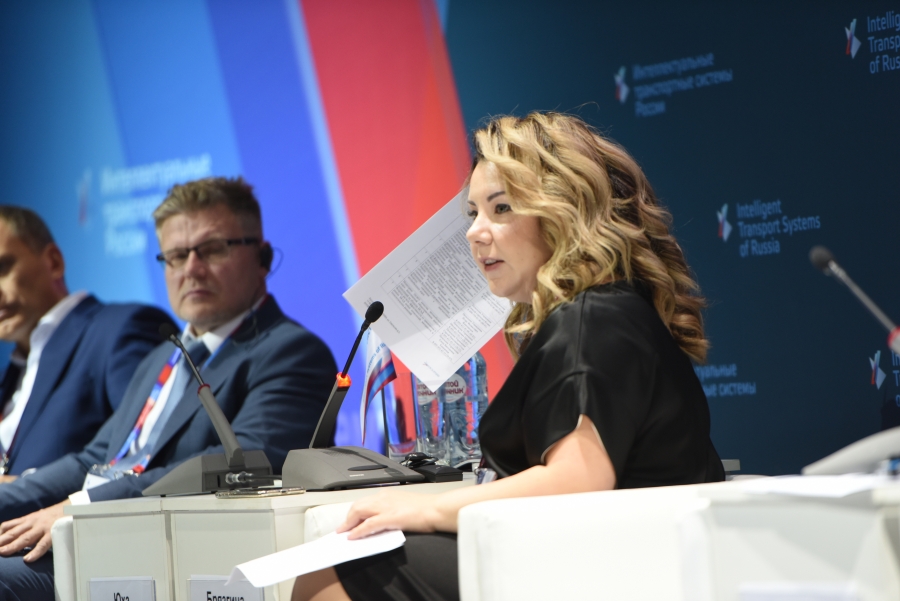
Ekaterina Bryazgina, Deputy General Director of the Federal State Enterprise "ROSDORNIA", said that the introduction of intelligent transport systems is part of the national project "Safe and High–quality Highways". Within the framework of the national project, the introduction of ITS will be aimed, among other things, at automating traffic control, automatically fixing traffic violations and weight and size restrictions, ensuring the safe movement of unmanned vehicles and the use of digital models in the road industry. So, in 2024, intelligent transport systems should be introduced within the boundaries of 64 urban agglomerations. "It's not that simple here. Since the national project provides support for the introduction of intelligent transport systems, certain requirements are imposed on the regions. Projects should be thorough, serious. That is, simply installing "smart" traffic lights in the amount of 6 pieces on the central street of the city will not be considered an intelligent transport system, accordingly, it will not be supported," Ekaterina Bryazgina warned. Intelligent transport systems will be introduced on 55 sections of highways to ensure the safe movement of unmanned vehicles, and about 750 automated weight and size control points will also be equipped on sections of federal and regional highways. As for the photo and video recording of violations, the number of cameras is planned to double by the level of 2017, the total number will be about 19 thousand pieces. Expert, methodological and informational support for the solution of these tasks within the framework of the national project is provided by the Branch Competence Center created on the basis of the Federal State Educational Institution "ROSDORNIA".
To implement intelligent transport systems, it is necessary to solve a whole range of tasks. In addition to standardization and technology development, the key condition is the creation of transport planning documents in the regions, in which measures for the creation and operation of ITS will be linked to measures for the development of transport infrastructure, the organization of integrated transport services for the population and the organization of traffic. Among other things, they talked about it already on the second day of the exhibition within the framework of the round table "Integrated development of transport infrastructure of cities and municipalities", which was co-organized by ROSDORNII. We are talking about the formation at the level of the subjects of the Russian Federation of Programs for the integrated development of transport infrastructure (PKRTI), integrated transport service schemes (CSOT). In urban agglomerations, in addition to these two documents, the development of integrated traffic management schemes (CSODD) will be required.
Also at the round table was presented a draft methodology developed by ROSDORNIA for evaluating regional initiatives and projects to create ITS, in order to further provide them with federal support. In addition to the level of elaboration, validity and "maturity" of ITS projects, the methodology also takes into account the availability and quality of preparation of transport planning documents in the regions. International experience will also be used in the implementation of intelligent transport systems. Thus, Juho Kenraali, Information Technology Director of the Agency for Transport and Communications of the Republic of Finland, told about the organization of work in this direction in Finland at the forum. He He noted that the work on technologies in the road transport sector should be tied to the real sector of the economy.
Representatives of the Russian and Finnish sides agreed on further exchange of experience in the implementation of pilot projects and technologies for their implementation. After the plenary session, a memorandum of cooperation was signed. In addition, a framework agreement was signed between the FAA "ROSDORNII" and the Association "Digital Era of Transport".
During the two days of the exhibition, at the stand of the FAU "ROSDORNII", the Institute's staff provided consultations on the preparation of documents for regional transport planning and the development of projects for intelligent transport systems. In addition, all participants of the forum and the exhibition received materials with contact details of the employees of the FAA "ROSDORNIA" to seek advice on various aspects of the implementation of the national project "Safe and high-quality highways".
The news is provided by the press service of the OCC
FAA ROSDORNII acted as the general partner of the event, in which, in addition to the participants of the expert and business community in the field of intelligent transport systems, representatives from public authorities of forty subjects of the Russian Federation took part.
At the plenary session, participants of discussions, sessions and round tables talked about common positions of the future digitalization of the transport industry. So, the deputy director of the Department of Development Programs of the Ministry of Transport of the Russian Federation, Yevgeny Tkachenko, identified the areas of tasks that need to be solved first. This includes, among other things, the readiness of the regions to implement ITS elements, the compatibility of the systems being developed and the training of personnel: "We need to prepare people who will be able to fully unlock the potential of intellectual transport systems, and the fact that they have the potential is so. Are there such specialists now? Are there enough of them?"
Ekaterina Bryazgina, Deputy General Director of the Federal State Enterprise "ROSDORNIA", said that the introduction of intelligent transport systems is part of the national project "Safe and High–quality Highways". Within the framework of the national project, the introduction of ITS will be aimed, among other things, at automating traffic control, automatically fixing traffic violations and weight and size restrictions, ensuring the safe movement of unmanned vehicles and the use of digital models in the road industry. So, in 2024, intelligent transport systems should be introduced within the boundaries of 64 urban agglomerations. "It's not that simple here. Since the national project provides support for the introduction of intelligent transport systems, certain requirements are imposed on the regions. Projects should be thorough, serious. That is, simply installing "smart" traffic lights in the amount of 6 pieces on the central street of the city will not be considered an intelligent transport system, accordingly, it will not be supported," Ekaterina Bryazgina warned. Intelligent transport systems will be introduced on 55 sections of highways to ensure the safe movement of unmanned vehicles, and about 750 automated weight and size control points will also be equipped on sections of federal and regional highways. As for the photo and video recording of violations, the number of cameras is planned to double by the level of 2017, the total number will be about 19 thousand pieces. Expert, methodological and informational support for the solution of these tasks within the framework of the national project is provided by the Branch Competence Center created on the basis of the Federal State Educational Institution "ROSDORNIA".
To implement intelligent transport systems, it is necessary to solve a whole range of tasks. In addition to standardization and technology development, the key condition is the creation of transport planning documents in the regions, in which measures for the creation and operation of ITS will be linked to measures for the development of transport infrastructure, the organization of integrated transport services for the population and the organization of traffic. Among other things, they talked about it already on the second day of the exhibition within the framework of the round table "Integrated development of transport infrastructure of cities and municipalities", which was co-organized by ROSDORNII. We are talking about the formation at the level of the subjects of the Russian Federation of Programs for the integrated development of transport infrastructure (PKRTI), integrated transport service schemes (CSOT). In urban agglomerations, in addition to these two documents, the development of integrated traffic management schemes (CSODD) will be required.
Also at the round table was presented a draft methodology developed by ROSDORNIA for evaluating regional initiatives and projects to create ITS, in order to further provide them with federal support. In addition to the level of elaboration, validity and "maturity" of ITS projects, the methodology also takes into account the availability and quality of preparation of transport planning documents in the regions. International experience will also be used in the implementation of intelligent transport systems. Thus, Juho Kenraali, Information Technology Director of the Agency for Transport and Communications of the Republic of Finland, told about the organization of work in this direction in Finland at the forum. He He noted that the work on technologies in the road transport sector should be tied to the real sector of the economy.
Representatives of the Russian and Finnish sides agreed on further exchange of experience in the implementation of pilot projects and technologies for their implementation. After the plenary session, a memorandum of cooperation was signed. In addition, a framework agreement was signed between the FAA "ROSDORNII" and the Association "Digital Era of Transport".
During the two days of the exhibition, at the stand of the FAU "ROSDORNII", the Institute's staff provided consultations on the preparation of documents for regional transport planning and the development of projects for intelligent transport systems. In addition, all participants of the forum and the exhibition received materials with contact details of the employees of the FAA "ROSDORNIA" to seek advice on various aspects of the implementation of the national project "Safe and high-quality highways".
The news is provided by the press service of the OCC