The St. Petersburg International Road Forum is held annually in St. Petersburg within the framework of the national project "Safe High-quality Highways". Within the framework of the forum, leading experts and industry leaders discuss topics such as the use of modern technologies and materials for paving in winter, improving the operation of snow removal equipment, as well as Russian innovations for road maintenance, similarities and differences in approaches to assessing the quality of winter maintenance in Russia and the world. The last such Forum was held on February 16-18 with the support of the National Association of Winter Road Maintenance. In the first part, we talked about the new national standards for the maintenance of highways.
Part 2. From theory to practice
Snowfall began in St. Petersburg at the end of November and continued throughout the winter. Periodically, the air temperature passed through zero degrees, which provoked first active melting of snow, and then - heavy ice. City road workers have been working in an enhanced mode for three months. However, many residents and visitors of the city are dissatisfied with the cleaning of the streets as in the historical part St. Petersburg, and in residential areas.
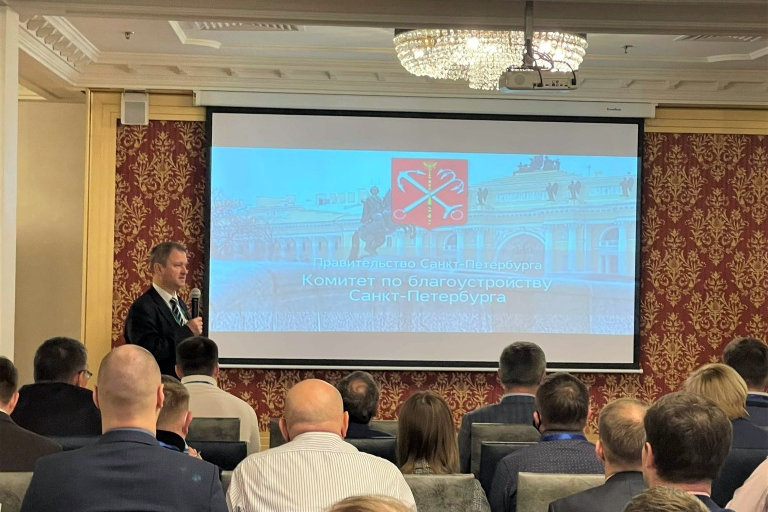
At the international road forum, Vadim Mizyukin, Head of the Department for Integrated cleaning and maintenance of roads of the St. Petersburg Improvement Committee, shared his experience of winter maintenance of streets and spoke about the problems faced by road workers during work. The total area of highways in St. Petersburg is 65 million square meters, in the area of responsibility of the Improvement Committee - 60 million square meters, of which 45 million are roadways, 15 million are sidewalks. Eight contracting organizations are engaged in winter maintenance of the city.
"Two years ago, the main priority for winter cleaning was given to the use of salt solutions based on sodium chloride. Although we have been working with them for more than 15 years. Over the past few years, we have purchased four new high-performance installations up to 50 cubic meters per use. We have equipment both for the roadway of direct treatment with salt solutions, and for sidewalks," Vadim Mizyukin said.
In order to avoid icing, the salt solution on the outbound highways begins to be used at night already in September. In addition to the liquid reagent in St. Petersburg , they use sand–and-salt mixture, in limited quantities - technical salt, and they rely on road sweeping.
However, such an approach to cleaning and a set of anti-icing materials is clearly insufficient, according to the forum experts, to cope with the winter conditions of St. Petersburg quickly. Given the high traffic intensity in the city (on many streets it exceeds 10 thousand cars per day, and on the ring road all 250 thousand), and a small park of harvesting equipment compared even with other cities, it is impossible to sweep the city and take out all the snow before it is packed with car wheels. As a result, an icy roll is formed, which leads to accidents. It is impossible to remove such a roll only with the help of technology. And salt solutions have shown their inefficiency in snowfalls and temperatures below minus 7C.
The representative of the Committee also noted the problem of clearing and processing sidewalks in the historical part of St. Petersburg:
"The most difficult thing for us is the sidewalks in the historical part of the city. They are narrow, the roofs are constantly dripping, everything is flowing. Of the 15 million square meters of sidewalks, 5 million are removed manually, the equipment does not come in. This is the most difficult direction that takes everything the main forces for solving the problem."
As for a possible solution, there is no need to go far for it. An interesting solution from an engineering point of view for local work on splitting ice on the narrow sidewalks of St. Petersburg and the possibility of replacing janitors with crowbars in their hands was demonstrated at the forum by Gleb Druzhinin, General Director of the NTO "Baraban". The Icebreaker device can carry out both preventive work to prevent the formation of ice, and to grind and remove ice or compressed snow.
The icebreaker is capable of removing ice sheets up to 20 cm thick. The cleaning speed reaches 200 meters per hour. The peculiarity is in the careful cleaning of the pavement covering, it does not damage the surface, including granite tiles, which is especially important for cleaning sidewalks in the historical part of St. Petersburg," explained Gleb Druzhinin.
The trend of abandoning sand and switching to road maintenance with the help of special deicing agents is gaining momentum: municipal authorities are increasingly reviewing approaches to road maintenance in winter due to new national standards, increased automobile and pedestrian traffic. Seemingly, at first glance, rising costs are becoming one of the barriers to the transition to advanced road maintenance technologies. However, practice shows that taking into account purely direct cost consequences gives incorrect information about the economic efficiency of innovative winter maintenance practices.
Methodological recommendations for evaluating the effectiveness of the use of innovative technologies for winter maintenance of roads were presented to the forum participants by Nadezhda Sakuta, Deputy Head of the ROSDORNII Project Office for Science. Nadezhda Borisovna explained how the calculation of socio-economic effects is carried out, and demonstrated the features of calculating the economic efficiency of winter maintenance.
"Innovation is not always something new that did not exist before, but something that may have been, but it is more effective and allows you to achieve new results, and it does not necessarily have to be cheaper," Nadezhda Borisovna emphasized.
So she gave an example of the transition of cities from sand-and-salt mixtures to multicomponent deicing reagents, noting a sharp decrease in accidents as one of the positive aspects, which makes it possible to attribute this method of winter cleaning to innovative.
Technological solutions for improving the quality of road maintenance, ensuring high throughput and road safety through the modernization of the infrastructure for the maintenance of road facilities were demonstrated by IST LLC. Sergey Mizitov, Executive Director of EAST LLC, spoke at the forum about the work of PGM preparation and storage complexes operating on a number of federal highways.
"These are the so-called pre-track complexes for the preparation, storage and rapid loading of liquid materials. They are on the highways M-10 "Russia", M-11 "Neva", M-3 "Ukraine", M-4 "Don", M-5 "Ural". They are two containers with a volume of 100 cubes each, two loading stations, a solution preparation station. Everything works in automated mode, the productivity is up to 6 cubic meters per hour," said Sergey Mizitov.
Due to this technology, the overall need for PGM is reduced due to the replacement of sand-salt mixtures with "pure" salts, the idling mileage of KDM is reduced by 3-4 times, the storage area of PGM is improved, the environmental situation.
Alexey Bulychev, Commercial Director of Russol LLC, presented the world experience in the use of salt to combat ice. According to him, Russian utilities are not the main consumers of reagents in the world. The TOP 7 leading countries in the use of anti-ice "chemistry" are: USA (20 million tons/year), Canada (5 million tons/year), Germany (2.5 million tons/year), France (1 million tons/year), South Korea (0.7 million tons/year), Norway (0.5 million tons/year) and Poland (0.46 million tons/yearyear). According to Russoli, in our country, enterprises of the road industry use 3.5-3.8 million tons of reagents in winter, including technical salt, depending on the "snowiness" of winter.
But there is a big difference in how reagents are used in Russia and abroad. In Europe and the USA, they are mainly used in their pure form. In Russia, it is mixed with sand.
"This is still the Soviet experience of fighting ice, which does not take into account modern requirements for a comfortable urban environment, for the quality and cleanliness of the surrounding air and ecology in general. Nowadays, more advanced methods of combating slipperiness on roads are available using both technical salt without admixture, and in combination with other chemical reagents based on NaCl. Such experience is being actively implemented in the capital, as well as in a number of regions of Russia – Novosibirsk, Krasnoyarsk, Tyumen, Tula, Rostov and Orenburg regions. Interestingly, the owners of toll roads in Russia were among the first to adopt these methods," said Alexey Bulychev.
The Ural Plant of Deicing Materials (UZPM) also presented a high-tech complex of storage, refueling and accounting of reagent at the forum. The stations are compact, convenient and easy to use, fully automated and equipped with a telemetry function for online control. They allow you to significantly reduce the time of refueling of special equipment, track the volume of consumption, control the quality and quantity of the product. As a novelty, UZPM presented its new development – a special dedusting compound for dust suppression in cities during the off-season and snowless winters.
"The efficiency is due to the property of the dedusting composition to bind small dust particles into larger ones, preventing them from rising into the air under the influence of wind and air flows from vehicles. The dedusting composition is intended for for roads with different types of coatings, including asphalt, as it does not create the effect of a slippery road, provides a dust-suppressing effect for more than 10 days, retains properties in the rain and does not freeze on roads even at minus 10 degrees. It is also recommended for dust suppression during construction and repair work, transportation of bulk and dusty cargo," explained Rudolf Ponomarev, Deputy Commercial Director of UZPM.
In Estonia, the length of all roads is 60 thousand km, including 16 thousand km of state roads. The population of the country is 1.5 million people . Ivan Nikitin, a leading engineer of the Road Maintenance Department of the Estonian Department of Transport, told about this at the forum. The country's territory is divided into 16 regions, contracts for the maintenance of state roads have been concluded with 10 companies. When determining the winners, the experience of the masters engaged in road maintenance, the average age of the equipment and ... sociability and speed of elimination of defects are evaluated first of all. Price is not the most important criterion.
The level of road maintenance in Estonia depends on the road category. Gradation - by traffic intensity.
"Estonia by traffic intensity can be characterized as a country with low traffic intensity: the average is 1 thousand cars per day. The highest figure is about 27 thousand cars per day. We also have roads where the traffic intensity is about 25 cars per day," Ivan Nikitin said.
The first level of maintenance is on the roads, where 250 cars pass per day. Their total length is about 8 thousand km, including gravel - 4 thousand km. According to the requirements, slipperiness is permissible on such roads, preventive actions are carried out within 12 hours, snow removal - also within 12 hours.
The second level of maintenance is on roads with a traffic intensity of 250-1000 cars per day. There are 4.5 thousand km of such in the country. They provide for the cleaning of the roadway, the elimination of slipperiness within 8 hours. The third level contains roads with traffic of 1-3 thousand cars per day. Their total length is 2.1 thousand km, they must be cleared of snow in 4 hours, the same amount of time is given to eliminate slipperiness.
The level of maintenance of three plus is carried out on roads with an intensity of more than 3 thousand cars per day, such as in Estonia - 1.7 thousand km, snow removal and the elimination of slipperiness on them should be carried out in 2 hours. For deicing treatment, pure reagents are used: liquid and solid.
The peculiarity of the Estonian winter is the rapid variability of weather conditions. Therefore, an important point is an accurate meteorological forecast, especially in anticipation of precipitation. To avoid ice, information provided by 98 meteorological monitoring stations for the road network is used. In case of a risk of ice formation, readiness for work on pretreatment of road surfaces with an anti-icing reagent is declared. Simultaneously with these measures, the condition of the coating is monitored by measuring the coefficient of adhesion of the car wheel to the road surface in winter.
"Winter maintenance measures are necessarily evaluated by both the customer and the contractor in terms of their impact on the coefficient of adhesion. We have it stipulated by the terms of the contract," said a representative of the Estonian Department of Transport.
Technologies of road maintenance in Finland were shared by the Director of the Department maintenance of the Finnish Transport Infrastructure Agency Magnus Nygard. According to him, winters in the country are completely different. In recent years they have been quite mild, and in 2017-2018 the weather conditions were not easy.
"In 2017-2018, we received massive negative feedback from the population about the quality of winter road maintenance. This required immediate decisions from us – the development of new principles for the maintenance of highways. The methodology for concluding contracts has been changed, new requirements have been introduced for contractors, including obtaining reports on the performance of work in real time. What effects did you get? We have achieved uniformity in quality, received clearer control methods, and achieved a reduction in accidents and injuries on the roads," Magnus Nygard said.
According to him, when choosing the method of winter maintenance of roads, many factors are taken into account, the key of which is the intensity of traffic and the importance of the road. Intensive routes (total length - 9600 km) should be completely cleaned to asphalt with the help of deicing reagents, there should be no ice on them under any circumstances circumstances. At the same time, there are roads of other categories that are allowed to be rolled.
He also announced a new model for concluding contracts for the maintenance of roads from 2019 - for a period of 5 years. The principle of choice is not by price, but by quality. Therefore, in Finland, all tenders for the maintenance of roads are put up at open auctions, when choosing a contractor, special attention is paid to his competence, equipment availability and personnel qualifications. Contractors' work is monitored online. The payment of the contract is based on the actual costs of the work performed.
Thanks to the implementation of the national project "Safe High-quality Roads" in 2021, more than 5 thousand road workers were trained in advanced training programs. The events were implemented with the support of the Russian Road Research Institute and the Russian University of Transport.
During 2021, the FAU "ROSDORNII" conducted classes on 21 advanced training programs, while 6 new ones were developed and 9 existing ones were updated. 5,161 people were trained. The share of listeners aged 18 to 35 years was 58.44%. Besides, 54 introductory and informational events on topical issues of road management were held, in which more than 5.3 thousand people took part in total, and more than 3.6 thousand industry workers watched webinars on the record.
Oksana Braslavskaya, the chief specialist of the testing laboratory of the Lenavtodor State University, was undergoing advanced training at the Russian University of Transport, classes were held remotely. She studied in several programs, among which - "Application of information modeling technology in road construction", "Technical means of organizing and ensuring road safety in the design, construction and operation of highways", "Use of the Register of new and best technologies, materials, technological solutions for reuse in the planning and application of new technologies".
"We live in a time when getting an education at the same time is not enough for a long time. It is important that the national road project makes it possible to study, as they say, on-the-job, when you are at work during the day, and in the evening you master the curriculum. It's great when the common goal of the whole country - the creation of high-quality roads - affects the development of the industry comprehensively from the operation of the skating rink on the highway to education," says Oksana Braslavskaya.
The acquired knowledge was applied in practice - last year in the Leningrad region, about 200 km were brought to the standard according to the national project. The share of facilities where the use of new and best technologies was envisaged was more than 80%. According to the chief specialist of the testing laboratory, last year GKU "Lenavtodor" significantly strengthened the quality control of the work of contractors.
Andrey Sharin, a leading engineer of the Department of construction and repair of highways of the State Unitary Enterprise "Yardorsluzhba", performed the functions of technical supervision at several objects of the national project in the Yaroslavl region: sections of the repair of the Uglich - Nekouz - Breitovo highway, Yaroslavl - Shopsha, Moscow - Arkhangelsk - Dubki.
"My task is to identify shortcomings in time and inform the contractor about it, if necessary, to suggest what to fix, how to comply with the declared technology, to organize the work correctly. I try to keep abreast of all innovations and regularly improve my qualifications, in in particular, thanks to these courses, where the maximum amount of subject and useful information is provided in a short period of time," said Andrey Sharin.
Ekaterina Kosyreva, an engineer of the production and technical department from Novokuznetsk, is a young specialist. Last year she studied at the educational portal of the FAU "ROSDORNII". I chose the course "Technologies of reuse of materials in the construction of structural layers of road clothes". This year Ekaterina will be involved in the control of repair work at the facilities of the national project "Safe quality Roads" as a production engineer in a contracting organization.
"Every year, changes are made to GOST standards to improve the quality of our roads and, as a result, improve the quality of people's lives. In order not only to be aware of innovations, but also to successfully apply them, it is necessary to increase the level of knowledge. And it doesn't matter if you've been in the profession for two years or 20. Everyone needs it," says Ekaterina Kosyreva.
It should be recalled that professional development of road workers is one of the indicators of the federal project "System-wide measures of road development" of the national project "Safe quality roads". In 2021, this indicator was exceeded by 2.58 times. The events were implemented with the support of the Russian Road Research Institute and the Russian University of Transport.