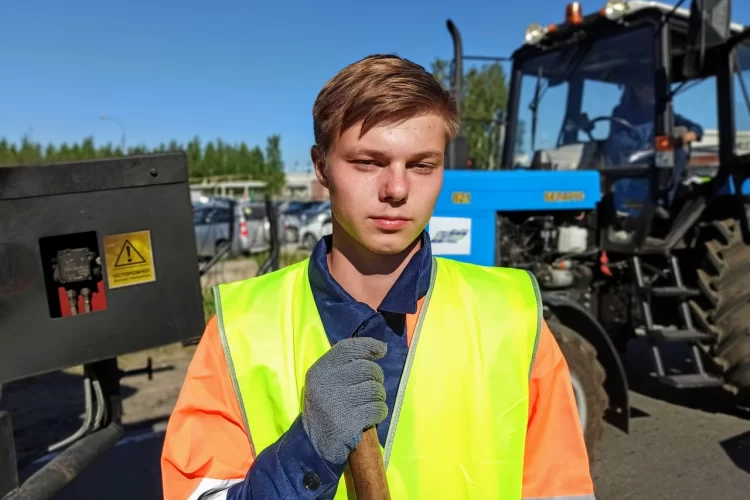
Experts discussed the problem of shortage of personnel in the road industry and the need to update federal educational standards
Experts have long noted an increasing shortage of workers for the country's road sector. The growth in the volume of road construction, increased requirements for the quality of road transport infrastructure, the introduction of the technical regulations of the Customs Union, changes in regulatory documents - all this sets an increasingly high level of requirements for the professional training of road specialists.
In order to form an estimated forecast of the personnel needs, the FAA "ROSDORNIA" in 2021 monitored the state of the personnel potential of the road sector. Based on information on 941 organizations engaged in the construction, repair and maintenance of highways provided by 85 regional road management departments, at the end of 2020, the average number of employees of road management organizations with higher education was more than
41 thousand people, with an average professional – more than 77 thousand. human.
According to the preliminary forecast, the annual need for personnel with higher and secondary vocational education until 2030 will average more than 83 thousand people per year. Of them with higher education – at least 29 thousand people, with secondary vocational - at least 53 thousand people.
Such data were made during the international seminar-meeting on the topic "Human resources in the road sector: potential, development, prospects", held
in the Public Chamber of the Russian Federation with the support of the Ministry of Transport of the Russian Federation, the Federal Road Agency, the Ministry of Education of Russia, representatives of regional ministries of education and public organizations.
Ilya Zotov, a member of the Commission of the Russian Federation on Housing, Construction and Roads, opening the discussion, noted that road construction in Russia is proceeding at a rapid pace, so staffing is of great importance in the construction of highways and bypasses of cities. "Road infrastructure projects make a significant contribution to improving the quality of life in the regions. One of the important factors affecting the speed of construction is the availability of personnel. Labor shortage the resources are very substantial, so we decided to discuss this topic with representatives of educational institutions, road workers, in order to formulate a list of recommendations
to force the solution of the personnel problem," Ilya Zotov said.
Indeed, the training of qualified personnel, the formation of new competencies and work skills, as well as the creation of a personnel reserve are of key importance in the road sector today.
Vladimir Paschanin, Acting Head of the Production and Technical Department of the state company Avtodor, told about the severity of the problem. In 2020, the state-owned company signed a contract for the design and construction of all stages of the high-speed four-lane highway M-12 Moscow - Nizhny Novgorod - Kazan with a length of 811 km with a completion date in 2024. This is a very high rate. For comparison: during the construction of the M-11, about 10 years passed from design to implementation.
The M-12 highway will pass through the territory of the Vladimir, Nizhny Novgorod regions, Chuvashia and Tatarstan, will allow unloading one of the busiest destinations in our country - the M-7 Volga highway and will connect major regional centers and agglomerations.
As Vladimir Pashchanin said, about 11 thousand people are currently involved in the construction of the highway, up to 38 thousand people will be required during the peak period. There is already a shortage of machine operators - 1600 drivers of dump trucks, cranes, bulldozers, stacker rollers and other types of equipment. There is a need for middle-level personnel, engineering and technical workers. High rates of construction require a faster pace in the preparation of working documentation — this means that it is necessary to additionally attract about 500 designers of the middle and entry level.
The supply of inert materials is also advancing – 15 million tons of crushed stone and 10 million tons of sand. Crushed stone is imported by rail, there is also a shortage of personnel, especially on the border with the Moscow region, where salaries are significantly higher compared to neighboring regions.
Sergey Konovalov, Head of the Analytical Reports Department at Transstroymechanizatsiya LLC (TSM), shared his experience in attracting students and graduates to the company's road facilities under construction. According to him, the TSM is also experiencing difficulties with staffing at all levels, starting from the line staff and ending with the management apparatus. This issue is most acute in engineering and technical structures - the geodesy service, the production and technical department, and the laboratory. In addition, the territorial removal of construction sites from large settlements dictates the need to organize a shift mode of work, which directly affects the number of all units.
"Contractors face a shortage of labor in the labor market, it is especially difficult to find ready-made specialists with the necessary qualifications. And it is often easier to prepare the right young specialist from a "clean slate" on your own, - says Sergey Konovalov. - In 2018, for the first time, we attracted young specialists during the construction of the Central Ring Road (launch complex No. 5), an experienced mentor was assigned to each of them. This format makes it possible not only to see the process from the inside, but also to become a direct participant in it, and subsequently start a career in the largest road company in Russia." By the way, the salary of young specialists provided with accommodation at the facility and three meals a day at the start is about 60 thousand rubles.
align="left"> In 2022, during the internship, TSM proposed a new format in which a student has the opportunity to get acquainted with the work of different departments in 30 days, visit all engineering services and choose a direction close to him. "Our task is to show the entire production process so that the trainee makes an informed choice of the future direction of work and further joins the ranks of the company's employees," concluded the representative of TSM.
Head of the Department of Human Resources Development of the Road Sector
FAA "ROSDORNII" Tatiana Markanich told about the system of advanced training for road workers, created as part of the national project of the BCD in 2021 and
about the plans for 2022 in terms of the development of educational activities.
According to her, in order to improve the staffing of road enterprises, a system of advanced training for industry workers was created, aimed at training and using new, best technologies, materials and technological solutions for reuse.
For this purpose, the specialists of the FAA "ROSDORNIA" have developed flexible, adapted and practice-oriented additional professional programs for a wide category of road workers in relevant priority areas, such as the design of the road network, diagnostics and assessment of the technical condition of artificial structures, operation of artificial structures as part of highways, operation of highways, the use of information modeling technologies for customer services, the use of information modeling technologies for project workers and expert organizations.
In 2021, 21 training programs were conducted, six programs were developed and nine programs were updated. More than half of the programs, for obvious reasons related to the coronavirus pandemic, were held in a remote format. More than 5 thousand road workers have been trained under these programs.
In addition, 54 events were held remotely, in which almost 9 thousand people took part in order to supplement, update and systematize knowledge regarding the implementation of the BCD national project.
An educational a portal for industry workers that ensures the availability and quality of modern forms of advanced training and professional retraining. A database is being created that contains an up-to-date list of regulatory legal acts of the Russian Federation in the field of road activities, information materials on amendments to the legislation of the Russian Federation being prepared for adoption, articles and opinions of experts on topical issues, methodological manuals with forms of documents, samples of their design and examples of the types of activities of customers in the field of road management.
Tatiana Markanich drew attention to the fact that during monitoring it is impossible to obtain information about graduates with higher education in the specialty "construction of highways, bridges and tunnels". "This is due to the fact that common control figures are allocated within the framework of construction, and the university itself determines whether it will be civil engineering or highway construction. This situation complicates our monitoring of human resources for the road industry and the possibility of its formation for employers," she notes.
Experts came to the conclusion that road specialists need to be trained from school so that the guys are oriented to the road industry, understand what professions are in demand there. However, teachers have such a law: we cannot teach what we do not know how to do ourselves. In this regard, the Minister of Education of the Orenburg region Alexey Pakhomov proposed to large customers - consumers of labor to invest in the preparation of teaching materials for teachers, additional education kits related to road construction, bridge construction, maintenance of equipment. "We need to start working with schools. This should be done by customers in order to reorient them to the needs of the road industry and not to "steal" ready-made personnel from other industries. And this will not require large financial costs. Starting out
from the 5th-6th grade, through a network of basic support schools, it is possible to form an array of children focused on entering colleges and specialized universities."
Director of the Department of State Policy in the field of secondary Vocational Education and Vocational Training of the Ministry of Education of Russia Viktor Neumyvakin noted the unprecedented interest in secondary vocational education: 60% of ninth graders choose colleges and technical schools. On behalf of the President of the Russian Federation, an additional 30 billion rubles have been allocated for the development of this sphere.
If in the 90s of the last century there was such a vicious practice when enterprises tried to take money for their internships by college students, now the situation has changed, enterprises have turned to colleges. At the same time, against the background of accelerating technological development, reducing the production cycle, it is necessary to update federal educational standards, their compliance with the needs of the economy, the expert believes.
An equally important issue is the material and technical base of colleges. Annually 4.3 billion rubles are allocated from the federal budget to upgrade the material and technical base, to create workshops. According to Viktor Neumyvakin, in 2022 about 400 colleges, including those related to road construction, will receive modern equipment. "Masters of industrial training, teachers are central figures in improving the quality of education. We are ready to change federal educational standards to meet the demands of the industry, to form programs to improve the qualifications of masters and teachers, based on the needs of employers," concluded the representative of the Ministry of Education.
So, suppose a future road worker chose his profession at school, graduated from a technical school or university in his chosen specialty, but what about employment?
Here, the All-Russian public Organization "Mobile Personnel of Russia" can come to the rescue, which assists in the mobility of students and graduates of higher and secondary educational institutions, is engaged in the organization of practices
and the employment of young people throughout the country, assists in the career growth of young professionals.
"Over the past year, 4 thousand graduates have passed through us," said Vladislav Shamin, chairman of the Board of the organization. For example, thanks to such cooperation, graduates of the Ryazhsky Road College were able to find jobs, not only at enterprises of the Ryazan region, but also in other regions of Russia.
Since 2018, he has been cooperating with Mobile Personnel of Russia and the Perm College of Transport and Service. "Thanks to this interaction, our students studying in the specialty "construction and operation of highways and airfields", "technical operation of lifting, construction, road machinery and equipment", have the opportunity to practice at the largest facilities of our country. More than 400 people have completed practical training on federal highways
M-11, M-12, M-4 and the Central Ring Road," said Olga Dramanova, deputy director of the college.
Thus, during the internship, students really get involved in work, work on road equipment, in laboratories, study the repair and maintenance of highways, and also earn good money. The best of them are included in the reserve of companies of the road complex.
Summing up, the participants of the discussion pointed out the need to synchronize the college admission figures with the actual market demand. Currently, the Ministry of Transport of Russia and Rosavtodor cannot influence the quota of admission control figures to secondary vocational educational institutions, since they have been transferred to the jurisdiction of the subjects of the Russian Federation, whose executive authorities are responsible for the formation of human resources in the interests of the development of their region.
align="left"> Workshops in secondary specialized educational institutions need to be updated, they need to be equipped with modern equipment. It is also necessary to transfer the production practice to the summer period in order to give students the opportunity to gain real skills on road facilities.The seminar participants also noted that not only builders, but also designers feel the personnel hunger. As a result of the discussion, a resolution was unanimously adopted in which the Government of the Russian Federation was recommended to form a working group to prepare a federal project aimed at developing the human potential of the road sector in order to implement the national project "Safe High-quality Roads" and a comprehensive plan for the modernization and expansion of the trunk infrastructure.
In addition, the participants of the event called for working out the issue of amendments to the legislation on education, which will make it possible to form control figures for admission to secondary specialized educational institutions, taking into account possible labor mobility, as well as to create a unified electronic register of road and related construction projects, where subsequently, young mobile cadres could work.
Источник: