
The new national standard will replace the industry documents of the last century
Rosstandart Order No. 468-st dated 06.08.2020 approved GOST R 58948-2020 "Public automobile roads. Winter automobile roads and ice crossings. Technical rules of the device and content". The standard was developed by specialists of the Russian Road Research Institute (FAA "ROSDORNII"). It introduces the classification of winter roads and ice crossings, regulates the conduct of survey work taking into account the use of modern equipment, establishes the rules for the construction and maintenance of overland winter roads, ice winter roads and crossings.
Winter highways (hereinafter referred to as winter roads) are an important part of the transport system of the regions of the North and provide transportation of goods and passengers during winter and spring periods. The total length of winter roads in the Russian Federation as of 01.01.2019 is about 21976 km, ice crossings - 535 km. In the Far Eastern and Siberian Federal Districts , the length of winter roads and ice crossings is 18737 km.
Up to now, winter trucks have been designed, arranged and operated in accordance with the industry regulatory and technical documents of the last century: VSN 137-89 "Design, construction and maintenance of winter highways in Siberia and the North-East of the USSR" and ODN 218.010-98 "Instructions for the design, construction and operation of ice crossings".
The new standard establishes technical rules for the installation of winter trucks and ice crossings in the climatic conditions of the northern territories and the Arctic of the Russian Federation with stable low temperatures, as well as their operation in winter.
Classification, survey work and design rules
The standard contains a classification of autozymers according to the following criteria:– by category (Iz, IIz, IIIz);
– according to the frequency of operation (regular, temporary, one-time use);
– by location on the ground (land and ice);
– by the duration of use (normal and extended service life).
Ice crossings are classified by length (small, medium and large) and by duration of operation (regular, one-time use).
The main technical standards for winter trucks and ice crossings include design speeds depending on their category and requirements for the elements of the transverse profile, plan and longitudinal profile.
The composition and scope of survey work is determined depending on the complexity of topographic, permafrost-ground and geological conditions, taking into account the development of the survey area and in agreement with the customer.
The rules for designing winter roads and ice crossings establish requirements for conventional overland winter roads, winter roads in swampy areas, with extended service life, ice winter roads and crossings.
Arrangement of autozymers and ice crossings
The device of land autozymers is carried out in two stages. At the first stage of the installation of autozymers on the ground, they mark the highway, clear the road strip from forests, shrubs and large stones; plan a soil foundation, perform earthworks on sloping areas, at exits from river banks and exits from them, as well as in areas where it is necessary to reduce longitudinal slopes; build bridges, pipes and anti-ice structures; build linear buildings; prepare unpaved quarries for work in winter conditions; prepare road signs and road signal milestones.
At the second stage, work is carried out on the direct arrangement of the autozymer, which begins with the layout of the dirt base of the roadbed. The method of the device of the snow (snow-ice) canvas of autozymers consists in the gradual build-up of the snow sheet during the winter on a prepared ground base and the device of snow mounds at the beginning of winter, followed by regular compaction of freshly fallen snow.
The device of ice autozymers and crossings is also carried out in two stages. At the first stage , the following preparatory work is carried out:– earthworks at exits from the banks of rivers, lakes and seas and exits from reservoirs; straightening and deepening of riverbeds in icy areas;
– procurement of materials and preparation of equipment to strengthen the ice cover;
– arrangement of linear buildings;
– preparation of road signs and milestones for the arrangement of an ice winter camp.
At the second stage of the device of ice autozymers and crossings after freezing (when the ice can withstand the load from road construction machines) perform:
– visual assessment of the state of the surface of the ice cover by special examination, including, if necessary, a helicopter flight of the route;
– measuring the thickness of the ice and the depth of the watercourse along the pre-planned route and the final laying of the route on the ground;
– preparation of the ice surface for traffic (clearing of snow, clearing of ice and hummocks) and strengthening of weak ice cover;
– arrangement of road signs and landmarks.
Maintenance of winter roads and ice crossings
According to the new standard, the maintenance of autozymers includes work on:
– elimination of damages and deformations of snow and ice sheets that occur during operation;
– implementation of measures to combat snow drifts;
– carrying out anti-ice and anti-avalanche measures;
– maintenance of technical means of traffic management and other elements of the arrangement in good condition.
According to the content of ice crossings, the list of works includes:
– elimination damage and deformation of the ice sheet;
– assessment of the bearing capacity of ice at negative air temperatures at least twice a month, in places with a fast current and in other most dangerous areas – once every 5-7 days; in spring and during winter thaws with an air temperature above 0 ° C – daily in order to determine the conditions of admission (speed and distance between cars) on the ice winter road and ferry;
– daily measurements of the thickness of the ice until it reaches the minimum permissible value for the passage of vehicles of various carrying capacities;
– monitoring the weight parameters of the loads passed through the ice crossing, without exceeding its carrying capacity.
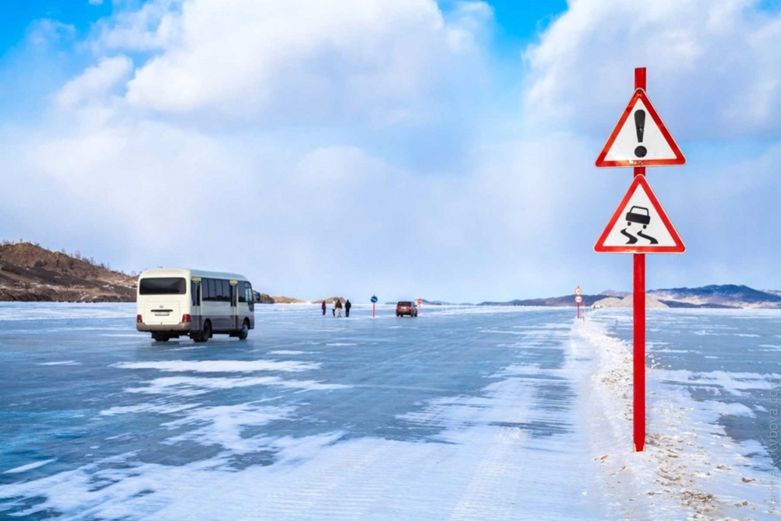
Ice crossing in the Ust-Pristansky district of the Altai Territory

Ice crossing "Khatass-Pavlovsk" Republic of Sakha (Yakutia)
Compliance with the requirements of the national standard GOST R 58948-2020 "Public roads. Roads automobile winter and ice crossings. The technical rules of the device and content" will ensure an increase in road safety, an increase in the speed and reliability of cargo delivery.