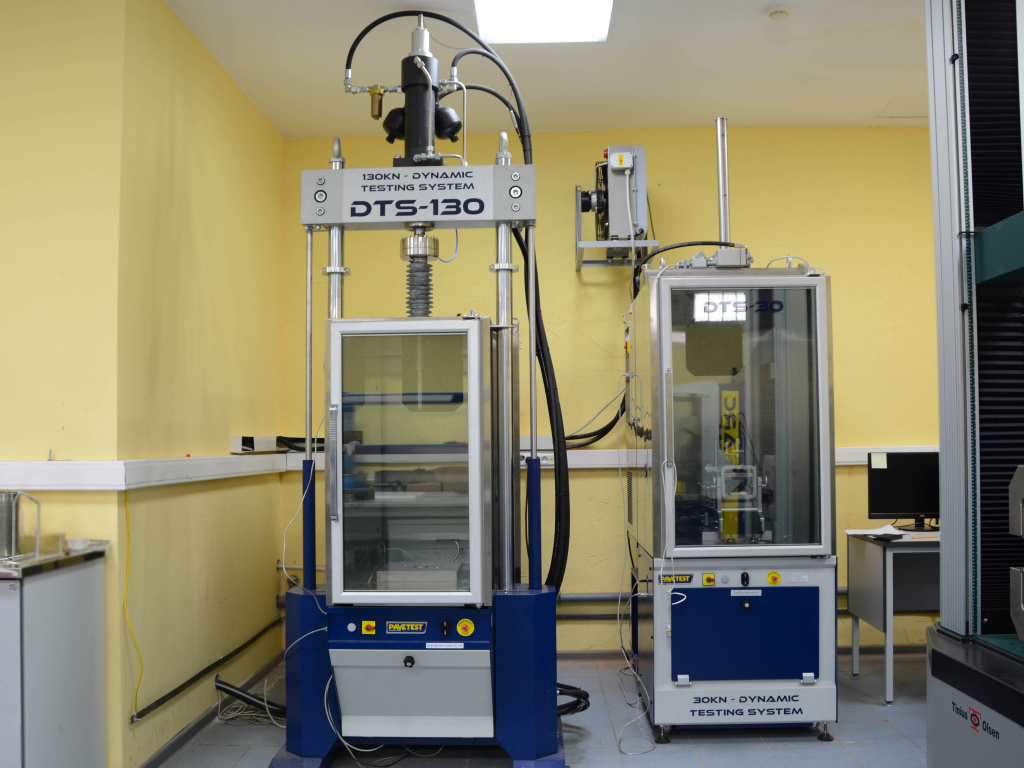
In 2020, a large-scale equipment upgrade is taking place in the stationary laboratories of the FAA ROSDORNIA within the framework of the national project "Safe and High-quality Roads". The new equipment is used as part of ongoing research and can be used for examinations of particularly complex issues of monitoring (auditing) the quality of road construction materials. We tell you about the installations and devices in detail.
A dynamic test system is a test installation with a servo—hydraulic drive. Such machines can be used in the mode of tensile load, dynamic compression load and are suitable for testing asphalt and cement concrete, as well as non-cohesive mineral materials.
Dynamic tests are subjected to samples both created in the laboratory and selected from road surfaces. The results are used to determine the properties of materials with their further use in the design of road clothes and structures, as well as to predict the life cycle of the coating.
The control of the highly efficient servo valve is digital, precise waveforms of the sinusoidal load with a frequency of up to 100 Hz are provided. Servo-hydraulic machines with 30 kN and 130 kN have a drive built into a rigid loading frame and are equipped with thermal chambers. The embedded software contains a complete set of pre-installed test methods according to all major international standards and step-by-step tips for the user when performing tests in accordance with standard methods.
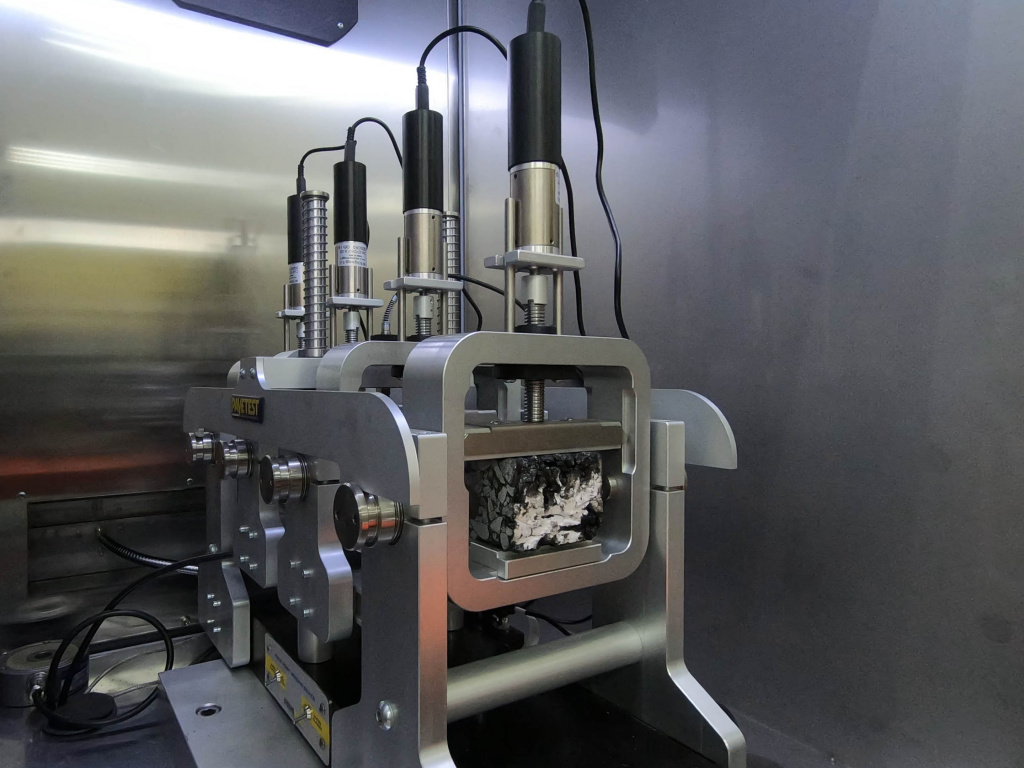
Various types of tests are carried out using removable sets of devices. So, with the help of a device for 4-point bending, the fatigue strength of the asphalt concrete beam is determined. The test is carried out in accordance with GOST R 58401.11-2019 "Public roads. Mixtures of asphalt concrete road and asphalt concrete.A method for determining fatigue strength under repeated bending". A multiple sinusoidal load with constant deformation (with repeated bending) is applied to a rectangular cross-section sample. The load is applied with a frequency from 1 to 10 Hz until the moment at which the initial stiffness of the test sample is reduced by 50%. This method characterizes the fatigue strength of asphalt concrete.
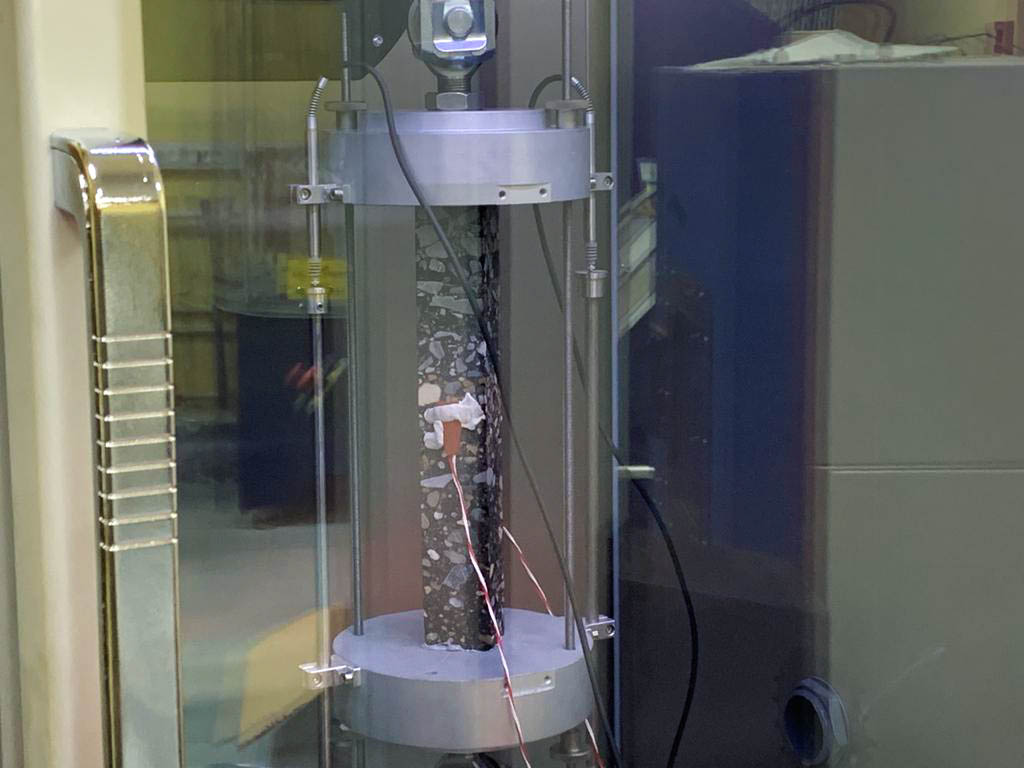
To determine the low-temperature strength and evaluate the characteristics of uniaxial tension, the capabilities of a thermal chamber are used. A rectangular beam or cylinder fixed at the ends is cooled in a temperature chamber until the moment of destruction due to thermal compression. Special devices register the change in the length of the sample, record the change in force.
It is also possible to determine the creep, tensile strength and Poisson's ratio of asphalt concrete; the dynamic modulus of elasticity of asphalt concrete and the phase angle in certain temperature ranges and load frequencies; the dynamic modulus of elasticity and the number of fluidity characterizing resistance to plastic rutting and dynamic loads. In addition, a test is carried out with triaxial compression of non-cohesive materials, simulating the loading conditions of the soil under the roadbed under the influence of a motor vehicle wheel to assess the modulus of elasticity; an assessment of the fatigue characteristics of asphalt concrete with indirect stretching of cylindrical samples is given, the resistance of asphalt concrete mixtures to crack resistance when bending a half-cylinder (SCB) is determined.